Achieving Higher Precision, Throughput, and Stability in Complex Multi-Axis Gantry Systems
In today’s most advanced semiconductor, electronics, and laser processing equipment, motion control is no longer just about achieving position—it is about achieving precision, synchronization, and throughput simultaneously. As machine architectures evolve toward larger formats, tighter tolerances, and higher speeds, traditional control approaches struggle to keep pace.
This is where Smarter Gantry Control powered by MIMO (Multi-Input Multi-Output) algorithms plays a decisive role.
The Challenge: Coordinating Coupled Axes in Gantry Systems
Gantry stages are foundational to many high-performance systems—from wafer inspection tools to advanced packaging platforms. These systems typically utilize multiple motors driving a single mechanical structure, such as an X-axis beam carried by dual drives.
While this architecture enables higher force and longer travel, it introduces complex dynamic challenges:
- Mechanical coupling between axes (cross-axis interaction)
- Structural flex and yaw errors
- Varying loads across the beam
- Disturbances generated by one axis affecting another
In conventional control approaches, each axis is treated independently (SISO control). However, in a gantry system, axes are inherently interdependent, and ignoring this coupling leads to:
- Reduced accuracy
- Lower bandwidth
- Increased settling times
- Limited throughput
Moving Beyond SISO: The Power of MIMO Control
MIMO control fundamentally changes how motion systems are managed. Instead of treating each axis in isolation, MIMO considers the entire system as a coupled dynamic entity, where multiple inputs (drive commands) influence multiple outputs (axis positions and errors).
ACS’s Smarter Gantry Control leverages advanced MIMO algorithms to:
- Actively compensate for cross-axis interactions
- Coordinate multiple motors as a single synchronized system
- Maintain performance consistency across the stage travel
This approach enables higher bandwidth, improved stability, and more predictable system behavior, even in complex mechanical configurations.
Smarter Gantry Control: Key Innovations
ACS’s implementation of Smarter Gantry Control introduces several critical capabilities designed for high-end precision systems:
1. Dynamic Cross-Axis Compensation
Instead of reacting to errors after they occur, the system dynamically compensates for the impact of the moving cross-axis load changing the overall systems behavior.
- Minimizes cross-coupling errors
- Reduces beam skew (yaw)
- Improves contour accuracy
This directly translates into better throughput and positioning performance.
Advanced algorithms continuously correct system-level errors that arise from:
- Structural compliance
- Thermal variation
- Load changes
These corrections ensure consistent nanometer-level accuracy, even under varying operating conditions.
3. Position-Independent Performance
Traditional gantry tuning often depends heavily on position. Performance degrades at the extremes of travel or under different load conditions.
MIMO-based control eliminates this limitation by delivering:
- Uniform performance across the entire working envelope
- Consistent accuracy independent of axis position
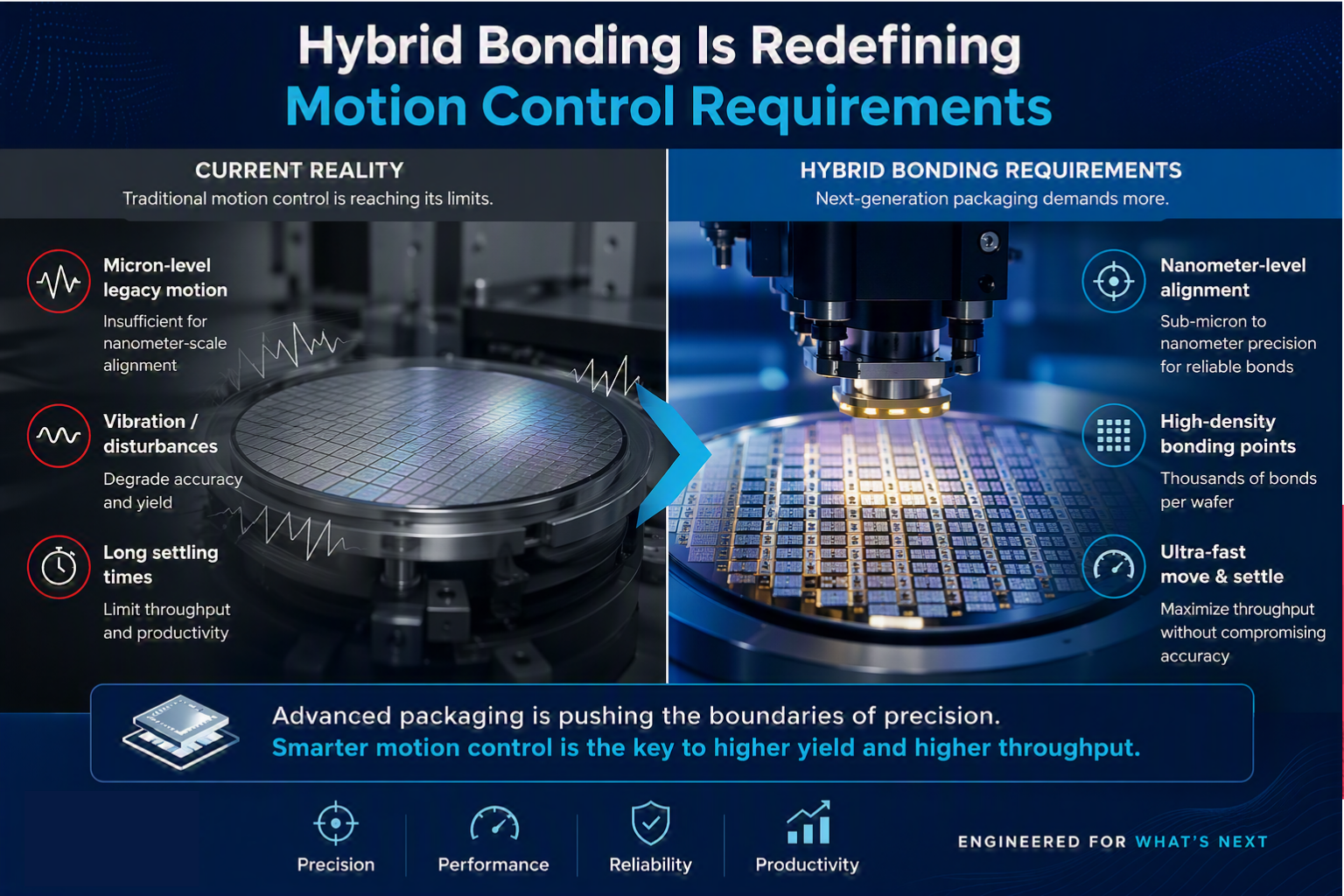
This is especially critical in applications like wafer inspection and hybrid bonding, where uniformity is essential.
4. Simplified Tuning and Optimization
Despite the complexity of multi-axis dynamics, Smarter Gantry Control simplifies implementation:
- Integrated tools like FRF Analyzer enable efficient tuning
- Advanced algorithms reduce manual tuning effort
- Robust performance across a wide range of stage designs
This allows engineers to achieve high performance faster, reducing time to market.
Real-World Impact: From Nanometers to Throughput
In advanced packaging and inspection systems, Smarter Gantry Control directly enables:
- Sub-nanometer positioning accuracy for bonding and metrology applications
- Faster move-and-settle times, increasing machine throughput
- Reduced vibration and improved process stability
- Higher yield through improved positioning precision
For example, bonding applications require extremely tight alignment tolerances. By combining MIMO control with advanced servo algorithms, systems achieve both speed and precision without compromise.
Why It Matters for Next-Generation Machines
As industries push toward:
- Smaller feature sizes
- Higher process speeds
- More complex multi-axis machine architectures
The limitations of traditional control approaches become increasingly evident.
Smarter Gantry Control addresses these challenges by enabling:
- Scalable performance for complex machines
- Robust handling of coupled mechanical systems
- Integration with advanced algorithms such as learning-based control and force control
This positions OEMs to build machines that are not only faster and more precise, but also more adaptable to future requirements.
Conclusion: Intelligent Control for Intelligent Machines
The transition from conventional SISO control to advanced MIMO-based Smarter Gantry Control represents a fundamental step forward in motion system design.
By treating the gantry as an integrated, dynamic system rather than a collection of independent axes, engineers can unlock:
- Higher accuracy
- Greater throughput
- Improved system robustness
In the era of advanced packaging, precision inspection, and high-speed manufacturing, this shift is not just beneficial—it is essential.