
Smarter Gantry and MIMO Control for Hybrid Bonding: Enabling Sub‑Nanometer Precision at Scale
|
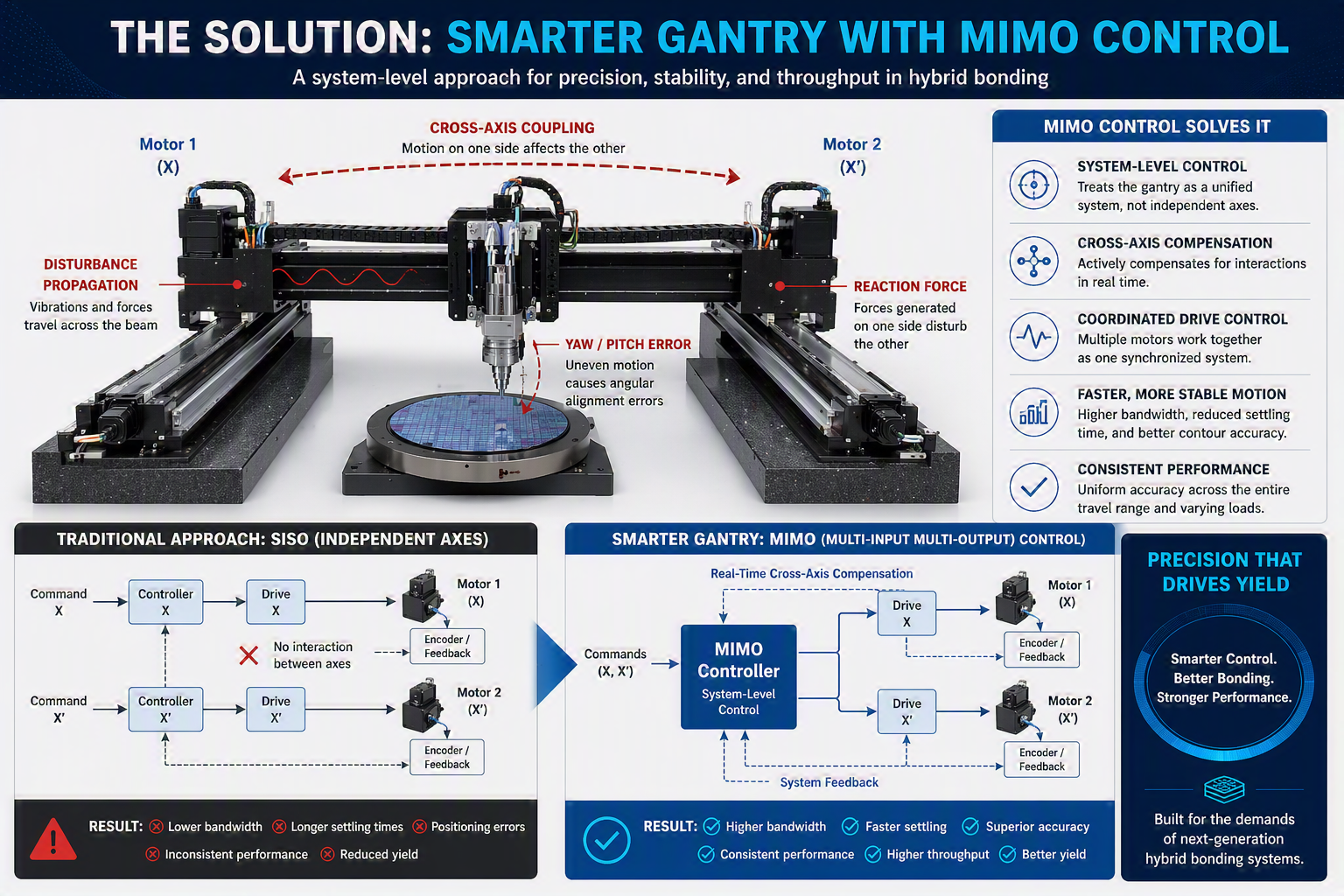
How advanced MIMO algorithms and intelligent gantry control help hybrid bonding systems achieve nanometer-level accuracy, faster settling, and higher yield
Hybrid bonding is redefining semiconductor manufacturing. As the industry shifts toward 3D integration and chiplet-based architectures, achieving reliable, high-yield bonding requires unprecedented levels of motion precision, speed, and stability.
At the heart of this challenge lies the motion system—especially gantry stages responsible for positioning bonding heads and wafers with extreme accuracy. Traditional control approaches are reaching their limits.
Smarter Gantry Control, powered by advanced MIMO (Multi-Input Multi-Output) algorithms, is emerging as a critical enabler for next-generation hybrid bonding systems.
The Hybrid Bonding Challenge: Extreme Precision Meets Extreme Throughput
Hybrid bonding introduces new motion control requirements that go far beyond legacy packaging:
- Alignment tolerances in the sub-micron to nanometer range
- Dramatically increased number of bonding points
- Faster move-and-settle times to preserve throughput
- Sensitivity to vibration, EMI, and mechanical disturbances
As advanced packaging evolves, the combination of smaller geometries and higher throughput requirements places enormous pressure on motion systems.
In particular, gantry stages used for wafer positioning and bonding must maintain nanometer-level accuracy while moving rapidly across large work areas.
Why Traditional Gantry Control Falls Short
Most gantry systems rely on dual motors driving a shared mechanical structure. While effective for force and travel, this architecture introduces complex challenges:
- Cross-axis coupling between motors
- Mechanical yaw and beam distortion
- Load-dependent performance variation
- Disturbances propagating across axes
Traditional control methods treat each axis independently. In hybrid bonding, this approach leads to:
- Positioning errors during fast moves
- Increased settling times
- Reduced bonding accuracy and yield
In short, independent axis control cannot meet the coupled dynamics of hybrid bonding systems.
MIMO-Based Smarter Gantry Control: A System-Level Approach
Smarter Gantry Control solves this problem by treating the gantry as a fully coupled dynamic system, rather than separate axes.
Using advanced MIMO algorithms, ACS motion controllers:
- Coordinate multiple motors as a unified system
- Compensate for interactions between axes in real time
- Maintain consistent performance across the entire working area
This approach delivers:
- Higher control bandwidth
- Improved stability
- More predictable and repeatable positioning
These characteristics are essential for hybrid bonding, where even nanometer-level errors can impact yield.
Key Advantages for Hybrid Bonding Applications
1. Nanometer-Level Positioning Accuracy
Smarter Gantry Control enables ultra-precise positioning required for bonding alignment.
- Supports sub-nanometer resolution and accuracy in advanced packaging processes
- Minimizes yaw and cross-axis errors during motion
This directly contributes to improved bonding alignment and higher yield.
2. Dynamic Cross-Axis Compensation
Hybrid bonding systems experience strong coupling effects during rapid motion.
MIMO control addresses this with:
- Real-time compensation of cross-axis disturbances
- Reduced mechanical interaction between drives
- Improved contour accuracy during movement
This capability improves both accuracy and throughput simultaneously, rather than forcing a trade-off.
3. Faster Move-and-Settle Performance
In hybrid bonding, throughput is driven by how quickly the system can move and stabilize.
Advanced control algorithms enable:
- Reduced settling times
- Faster execution of short-duration moves
- Minimized vibration during positioning
These improvements are key to maintaining throughput as bonding densities increase.
4. Consistent Performance Across the Wafer
Hybrid bonding requires uniform performance regardless of position on the stage.
Smarter Gantry Control delivers:
- Position-independent accuracy
- Stability across full travel range
- Reliable performance under varying loads
This ensures consistent bonding quality across the entire wafer or panel.
5. Simplified Commissioning for Complex Systems
Despite the complexity of MIMO control, integrated tools and algorithms reduce engineering effort:
- Advanced tuning tools streamline optimization
- Automated compensation reduces manual intervention
- Faster time-to-performance for new machine designs
This aligns with OEM needs to accelerate development cycles while meeting tighter specifications.
Real Impact: Improving Yield, Throughput, and Reliability
Hybrid bonding is highly sensitive to motion performance. A single positioning error can result in:
- Misalignment
- Bond failure
- Reduced yield
Smarter Gantry Control directly addresses these risks by:
- Improving alignment precision
- Reducing vibration and disturbance
- Ensuring repeatable positioning
At the same time, faster motion and reduced settling enable higher productivity, supporting the dual requirement of precision and throughput.
Built for the Future of Advanced Packaging
The transition to hybrid bonding and 3D integration is driving demand for:
- Higher precision (<10 µm pad & bump pitch and even much further below)
- Faster process speeds
- More complex multi-axis architectures
These trends make advanced motion control capabilities essential.
ACS solutions combine:
- Multi-axis synchronization
- Advanced servo algorithms
- MIMO-based gantry control
- Scalable EtherCAT architectures
This integrated approach allows OEMs to design machines capable of meeting both current and future hybrid bonding challenges.
Conclusion: Precision Motion as a Competitive Advantage
Hybrid bonding represents a new frontier in semiconductor manufacturing—but it also redefines the requirements for motion control.
Smarter Gantry Control, powered by advanced MIMO algorithms, enables machine builders to:
- Achieve nanometer-level accuracy
- Increase throughput without sacrificing precision
- Ensure consistent, repeatable performance
For OEMs developing next-generation hybrid bonding equipment, motion control is no longer just a subsystem—it is a critical differentiator for performance, yield, and market success.