
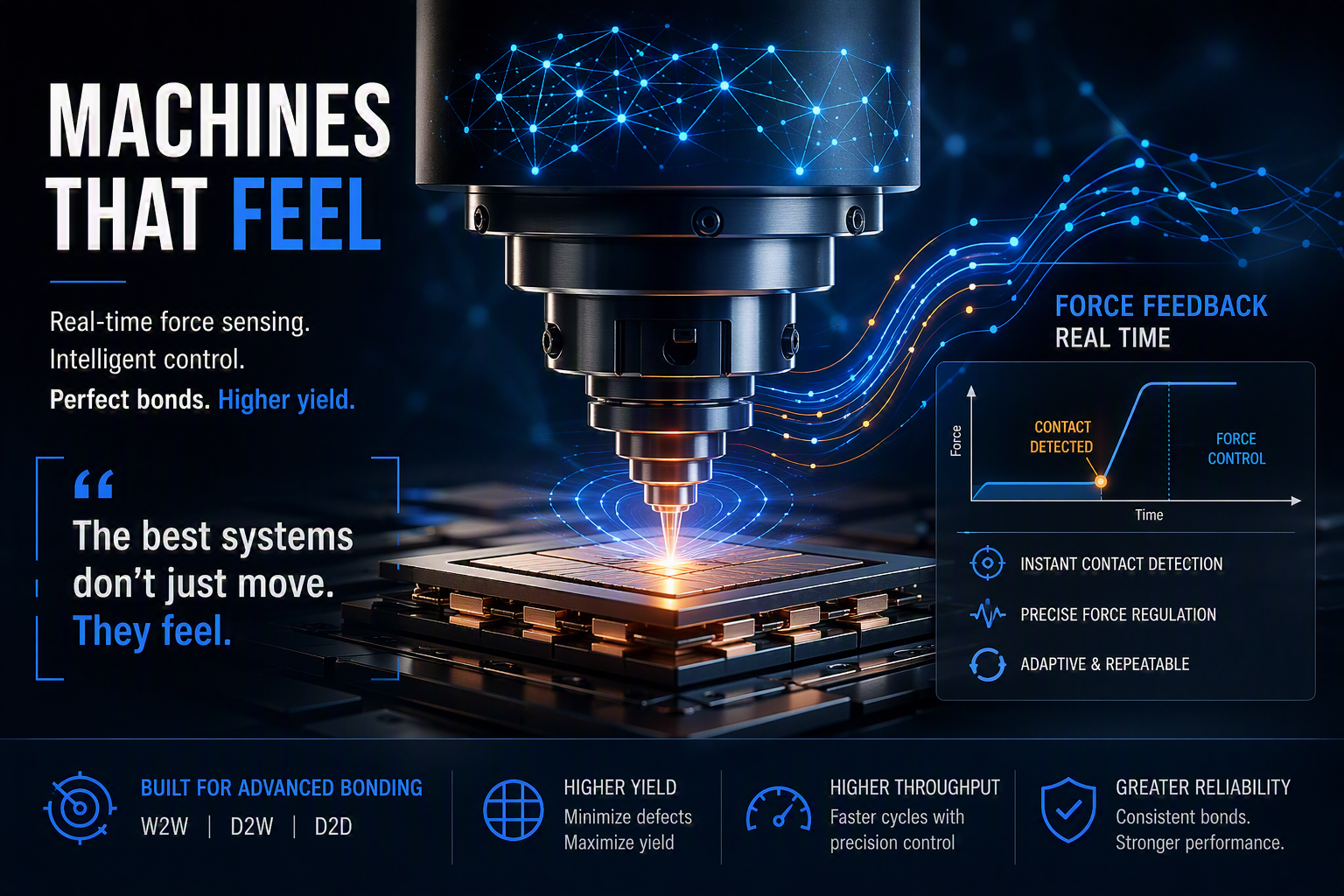
How Precision Force Control Enables Advanced Packaging Performance
As semiconductor devices continue to evolve toward heterogeneous integration and 3D architectures, bonding technologies such as hybrid bonding and thermal compression bonding (TCB) have become foundational to advanced packaging. These processes—spanning wafer-to-wafer (W2W), die-to-wafer (D2W), and die-to-die (D2D) bonding—place unprecedented demands on motion systems.
Among these demands, force control is emerging as a critical enabler of both process performance and yield.
Why Force Control Matters in Advanced Bonding
Hybrid bonding and TCB processes rely on precise mechanical interaction between ultra-flat, nano-scale surfaces. The goal is to achieve strong electrical and mechanical interconnects while avoiding damage to fragile structures such as copper pads, dielectric layers, and ultra-thin wafers.
Key process sensitivities include:
- Contact force magnitude
- Force uniformity across the bonding interface
- Force timing and ramp rates
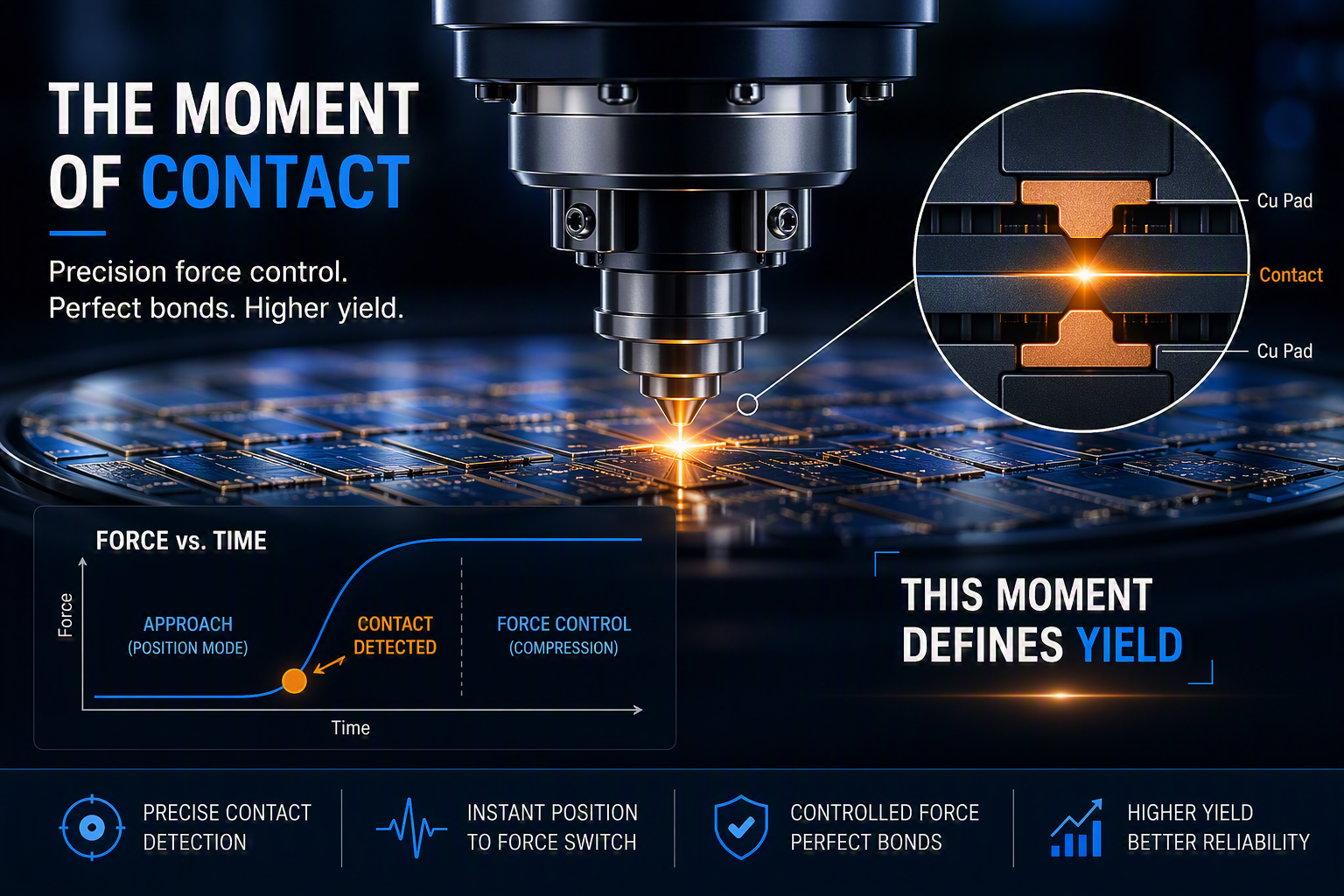
- Dynamic switching between position and force modes
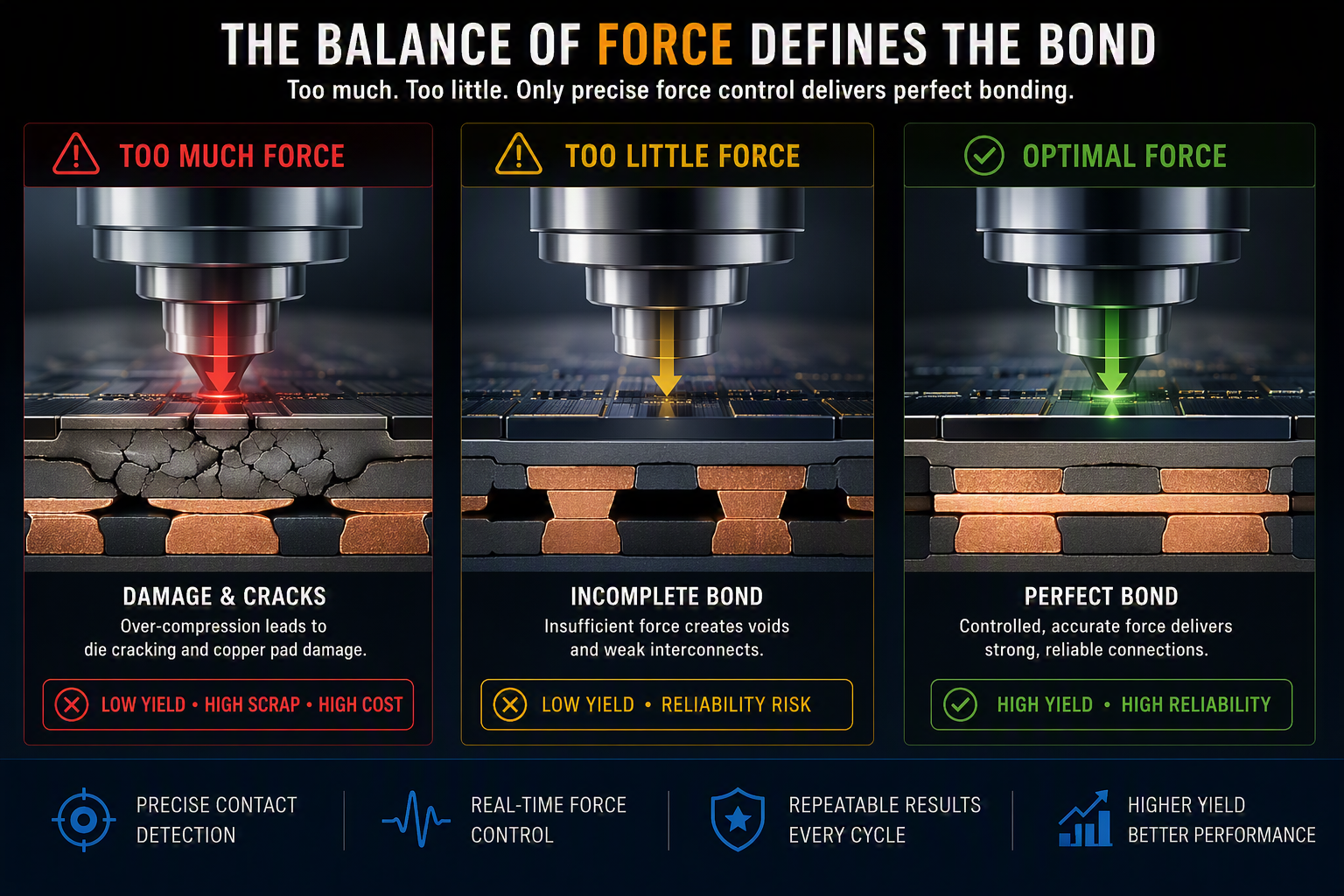
Inadequate force control can lead to:
- Voids or incomplete bonds
- Die cracking or warpage
- Misalignment during bonding
- Reduced yield and long-term reliability risks
This is particularly critical in hybrid bonding, where extremely fine interconnect pitches demand sub-micron alignment combined with tightly controlled force application.
Force Control Challenges Across Bonding Modes
Wafer-to-Wafer (W2W) Bonding
W2W bonding requires applying force uniformly across an entire wafer surface.
Key challenges:
- Maintaining global planarity and force uniformity
- Managing wafer bow and thermal expansion
- Avoiding localized over-force that can damage structures
Force control systems must ensure:
- Smooth force ramp-up across large surfaces
- Stable force regulation during thermal cycles
Die-to-Wafer (D2W) Bonding
D2W bonding introduces variability as individual dies are placed on a wafer.
Key challenges:
- Compensating for die height variation
- Achieving repeatable force at each placement location
- Maintaining throughput with rapid pick-and-place cycles
Here, force control must be:
- Fast and responsive for high-throughput placement
- Capable of on-the-fly contact detection
- Robust to part-to-part variation
Die-to-Die (D2D) Bonding
D2D bonding pushes precision even further, often used for chiplet integration.
Key challenges:
- Extremely small bonding areas
- High sensitivity to force overshoot
- Tight coupling between alignment and force application
This requires:
- High-bandwidth force loops
- Precise synchronization between motion axes and force application
- Ultra-low noise and vibration
Critical Force Control Capabilities for Bonding Processes
To address these challenges, advanced motion controllers must deliver a combination of real-time precision and flexibility.
1. High-Bandwidth Force Loops
Fast dynamic response is essential to:
- Detect initial contact without overshoot
- Regulate force during bonding
- Adapt to material deformation
2. Sensor-Based and Sensorless Force Modes
Modern systems leverage both:
- Sensor-based force control (load cells, force sensors) for maximum accuracy
- Sensorless force control using motor current/observer models for cost and integration advantages
These modes can be switched dynamically depending on the bonding stage.
3. Smooth Force Profiles and Multi-Segment Control
Hybrid bonding and TCB processes require:
- Controlled force ramp-up and ramp-down
- Multi-stage profiles (approach, contact detect, compression, hold, release)
Advanced control platforms support multi-segment force profiles to optimize each phase of the bonding cycle.
4. Real-Time Mode Switching (Position ↔ Force)
Bonding sequences depend on:
- Precise positioning during alignment
- Immediate transition to force control during contact
This requires deterministic switching with no discontinuities—ensuring process stability and repeatability.
5. Synchronization Across Axes and Systems
In advanced tools, bonding is not an isolated axis:
- Z-axis force must be synchronized with XY alignment stages
- Thermal systems must be coordinated with force application
- High-speed automation systems must maintain cycle time targets
ACS platforms, for example, provide real-time multi-axis synchronization and deterministic control, enabling cohesive system-level performance.
Applying Force Control to Hybrid Bonding
In hybrid bonding, the bonding quality depends on:
- Initial oxide-to-oxide contact (low force regime)
- Followed by metal (Cu-Cu) interconnect formation (higher force/thermal regime)
Force control enables:
- Gentle contact detection to avoid particle-induced defects
- Controlled transition to compression phases
- Accurate force distribution to ensure uniform bond formation across micro-bumps or pads
Because hybrid bonding operates at extremely fine pitches, the motion system must combine:
- Sub-micron positioning accuracy
- High-fidelity force regulation
- Minimal mechanical disturbance
Applying Force Control to Thermal Compression Bonding (TCB)
TCB introduces additional thermal dynamics:
- Elevated temperatures soften materials
- Force must be maintained consistently during thermal expansion and deformation
Key force control requirements include:
- Stable force regulation over time and temperature
- Compensation for creep and relaxation effects
- High repeatability for mass production environments
Multi-segment force profiles are especially critical here, ensuring optimal bonding conditions throughout heating, compression, and cooling phases.
Enabling High Throughput Without Sacrificing Precision
A common misconception is that tighter force control compromises throughput. In reality, advanced motion platforms enable both:
- High-speed contact detection reduces cycle time
- Adaptive force control minimizes rework and scrap
- Learning-based algorithms improve repetitive process performance
ACS solutions leverage real-time control, advanced algorithms, and integrated motion/force capabilities to maximize both yield and throughput in semiconductor manufacturing environments.
Conclusion: Force Control as a Strategic Differentiator
As advanced packaging continues to scale—driven by AI, HPC, and chiplet architectures—bonding processes will become even more demanding.
Force control is no longer a secondary feature. It is a core technology differentiator that directly impacts:
- Yield
- Reliability
- Throughput
- Process scalability
For OEM machine builders, investing in advanced motion platforms with integrated, real-time force control is essential to staying competitive in the next generation of semiconductor manufacturing.