
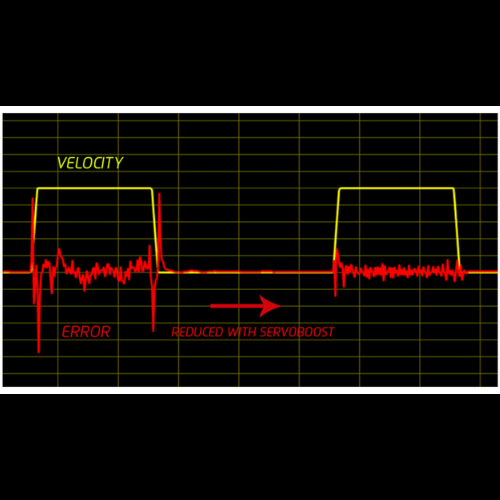
In automation of high volume production processes – every millisecond of cycle time matters. As precision stages move faster and accuracy demands tighten, traditional PID‑based control schemes often become the bottleneck. ACS Motion Control’s ServoBoost algorithm directly addresses this challenge, providing a quantum leap forward in servo performance that translates into higher throughput by decreasing overall move‑and‑settle times while increasing overall system stability.
What is ServoBoost?
ServoBoost is an advanced servo control algorithm integrated into ACS Motion Control’s SPiiPlus Platform servo drives. It leverages dedicated Servo Processor hardware and modern control theory to significantly outperform linear PID/PIV servo loops—an essential requirement for machines with demanding move‑and‑settle, standstill jitter, and constant-velocity specifications.
In the ACS portfolio, ServoBoost is highlighted as part of the SPiiPlus EtherCAT Motion Control Platform improving motion system performance with a unique computational approach that dynamically adapts to the system’s behavior.
Limitations with Standard Servo Control
High-precision motion stages face several performance-limiting factors:
- Mechanical resonances
- Varying payload dynamics
- Encoder noise and nonlinearities
- Cross-axis coupling in gantry or multi-axis platforms
- Inconsistent performance across machines, causing long tuning cycles and production delays
These commonly manifest as longer settle times, position error oscillations, or velocity ripple – all directly reducing machine throughput.
ServoBoost Addresses Limitations to Improve Throughput
1. Reduces Move-and-Settle Time
ServoBoost’s advanced compensation algorithms analyze system errors in real time and applies optimal corrective actions at high frequency.
- Stages arrive at target positions sooner
- Process tools (cameras, lasers, probes) engage earlier
- Short-move sequences (e.g., inspection, die attach, scanning) achieve higher cycle rates

Red: Position error with ServoBoost
2. Minimizes Velocity Error for Higher Constant‑Velocity Performance
For scanning, imaging, and laser‑processing applications, constant velocity is critical. ServoBoost significantly reduces velocity ripple, yielding smoother motion and allowing higher feed rates without degrading process quality.
3. Enhances Stability Across Frequency Ranges
Traditional servo loops struggle with mechanical resonances — especially large‑format stages and tools with cantilevered masses. ServoBoost identifies these resonances and automatically attenuates them to minimize effects on the system. Additionally, ServoBoost also integrates seamlessly with complementary ACS features like MotionBoost, SmoothPTP, and Input Shaping, which further reduce motion‑induced resonances to increase throughput.

Blue: w/ standard servo algorithm
Red: with ServoBoost
4. Reduces the Need for Extensive Manual Tuning
OEMs frequently struggle with tuning consistency from prototype to production systems. ACS explicitly highlights that ServoBoost helps address variability in system performance and reduces the burden on engineering teams. This makes scaling production faster and more predictable.
5. Improves Stability in High-Duty-Cycle Applications
ServoBoost’s real-time correction ensures stable performance compensating for mechanical wear, and variable loads over time.


Red: Position error with standard servo algorithm Green: Position with ServoBoost
Conclusion: A Simple Upgrade with Significant Throughput Payoff
ServoBoost represents a major advancement in servo control performance, and because it is easily activated in ACS motion controllers and drives, OEMs can activate these benefits without mechanical redesign.
For machine builders pushing the limits of speed and precision, ServoBoost provides:
- Higher throughput
- Improved accuracy
- Reduced tuning time
- More consistent performance across machines