Machine builders are being asked to do something increasingly difficult: move faster without sacrificing precision.
In semiconductor manufacturing, advanced packaging, electronics assembly, laser processing, inspection and metrology, and other high-performance automation applications, increasing throughput often requires higher acceleration, higher jerk and shorter move-and-settle times. At the same time, tighter process tolerances leave less room for position error, velocity variation, vibration or settling delay.
Eventually, traditional servo control reaches practical limitations. Mechanical resonances, changing system dynamics, cross-axis reaction forces and structural compliance can become increasingly problematic as motion profiles become more aggressive.
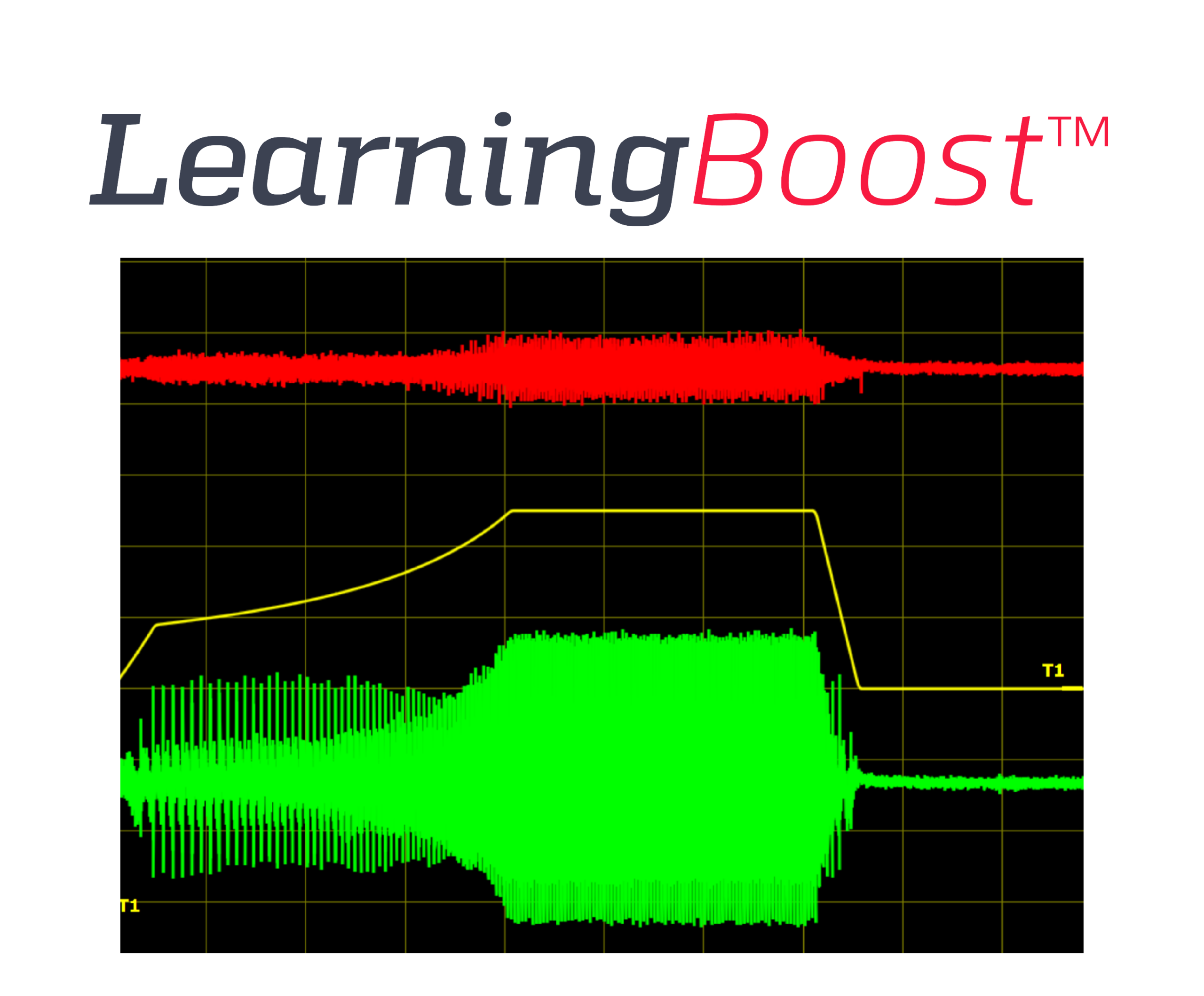
LearningBoost™ from ACS Motion Control was developed for these challenges. It is an adaptive embedded AI control algorithm for high-dynamic precision motion systems, designed to learn and adapt to errors and changes in motion-system behavior and apply pre-emptive compensation to reduce errors before they materialize.
The objective is straightforward: enable higher machine performance and throughput while reducing the engineering effort required to achieve it. This is the main benefit to utilizing LearningBoost.
Why conventional servo control can become the bottleneck
A well-designed servo system continuously works to minimize the difference between commanded and actual motion. But demanding machines increasingly operate in a performance range where simply optimizing conventional servo parameters may not address every source of dynamic error.
Common challenges include:
- increasing throughput requirements
- higher acceleration and jerk
- cross-axis disturbances in mechanically coupled systems
- mechanical compliance
- resonance during aggressive motion
- changes in inertia, mass or temperature
- short move-and-settle sequences
- precision requirements that push beyond standard control performance
Consider a mechanically coupled dual gantry system. An aggressive move on one gantry can generate reaction forces that disturb the other gantry axes. The disturbance may be brief, but when the machine must execute hundreds or thousands of high-dynamic moves with process requirements (such as inspection/metrology or bonding), those errors and the time required to recover from them can have a significant effect on overall process throughput.
The challenge becomes even greater when the machine’s dynamics change with operating conditions.
LearningBoost adds an adaptive layer to the motion-control system specifically designed for these types of challenges.
What is LearningBoost?
LearningBoost is an adaptive embedded AI control algorithm available on select products within the SPiiPlus™ Platform. Its purpose is to improve the performance of precision stages operating in highly dynamic applications.
Rather than relying exclusively on reactive correction, LearningBoost learns and adapts to motion-system behavior and uses pre-emptive compensation to reduce errors before they develop.
This approach can provide several important advantages.
1. Reduce cross-axis reaction-force errors
In mechanically coupled systems such as gantries, dual gantries and cantilevered XYZ architectures, motion on one axis can produce a reaction force that affects another.
LearningBoost is particularly effective at compensating for these cross-axis disturbances. That makes it highly relevant to equipment where aggressive XY motion and tight process tolerances occur simultaneously.
2. Support more aggressive motion
Higher machine throughput frequently requires increasing velocity, acceleration or jerk. Unfortunately, more aggressive profiles can also amplify dynamic errors and resonances.
LearningBoost can reduce error during high-acceleration portions of a move, potentially allowing the motion system to operate at higher dynamic performance while remaining within process tolerances. Additionally, LearningBoost can identify higher frequency resonances created by more aggressive motion profiles & apply corrective signals to avoid exciting these resonances.
3. Extend system bandwidth beyond standard control
The LearningBoost strategy uses predictive compensation and is designed to provide higher effective control performance than standard servo control alone, including compensation of higher-frequency disturbances and resonances.
4. Adapt to changing machine behavior
Real machines do not remain perfectly constant throughout their operating life.
Mass and inertia can change. Temperature changes can influence mechanical behavior. Compliance varies between machines and operating conditions.
LearningBoost can compensate for errors associated with inertia or mass, temperature and mechanical-compliance changes, helping the control system maintain more consistent performance as conditions change.
5. Reduce engineering and commissioning effort
Extracting the last increments of performance from a precision stage can traditionally require considerable tuning and system analysis. In other words, a lot of time and extra work.
LearningBoost includes flexible learning and compensation options as well as a graphical user-interface wizard intended to simplify setup and optimization. The system supports online adaptive learning, but engineers can also learn the system, save the resulting configuration and operate with adaptation disabled.
That provides an important combination for production equipment: adaptation where it provides value, with the option to operate using fixed learned parameters when required. All that said, LearningBoost provides engineers a tool to not only meet their motion system requirements but do it in significantly less effort and time.
LearningBoost + ServoBoost: complementary approaches to motion performance
LearningBoost becomes especially compelling when paired with ServoBoost™.
ServoBoost is ACS Motion Control’s advanced servo-control technology designed to identify and compensate for common errors, disturbances and resonances in precision stages in real time. It can deliver faster settling, lower standstill jitter, improved constant-velocity performance, increased stability and greater disturbance rejection.
LearningBoost addresses the problem from a complementary direction by learning system behavior and applying pre-emptive compensation.
Together, the technologies target four metrics that matter directly to high-throughput, precision motion equipment:
faster settling + better stability + lower position error + smoother velocity
For a deeper look at the complementary technology, read How ServoBoost Improves Machine Throughput.
Standard Control
LearningBoost enabled
ServoBoost + LearningBoost
motion & standstill

Where can LearningBoost make the greatest impact?
LearningBoost is particularly relevant anywhere aggressive motion intersects with stringent dynamic accuracy requirements. ACS Motion Control conducted a number of emulated applications and real-world testing to demonstrate the power and capability of the algorithm.
Advanced packaging: hybrid bonding, TCB, die and LED bonding
Advanced packaging processes demand increasingly fast positioning while maintaining extremely tight alignment and process control.
In hybrid bonding, thermocompression bonding (TCB), die attach and LED bonding, rapid motion in mechanically coupled stages can create cross-axis disturbances. Reducing those disturbances while shortening move-and-settle time creates a direct opportunity for increased tool throughput.
Table for image right:
| Settle window (nm) | Settle time PID (ms) | Settle Time SB+LB (ms) |
| 200 | 37.5 | 0 (100% ↓) |
| 100 | 118 | 32 (73% ↓) |
| 50 | 126 | 49 (61% ↓) |
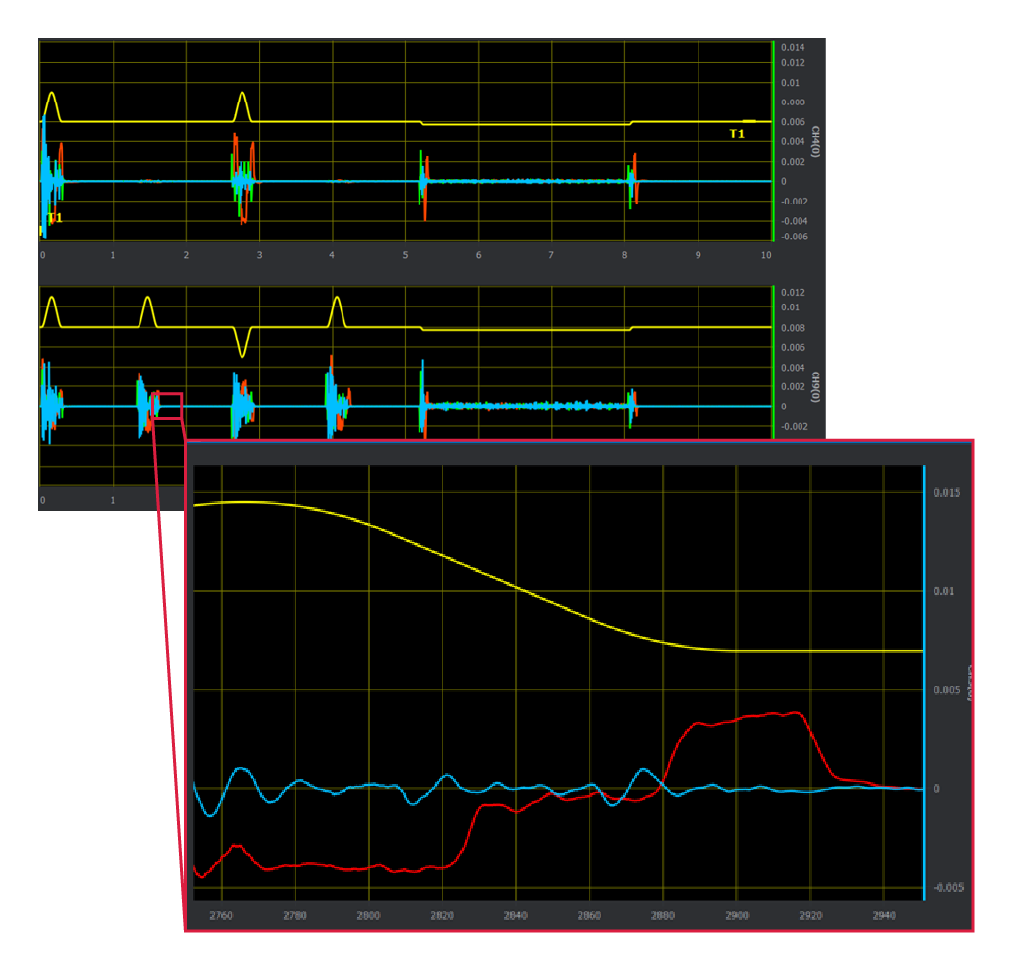
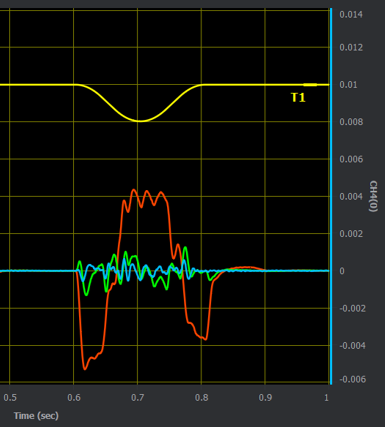
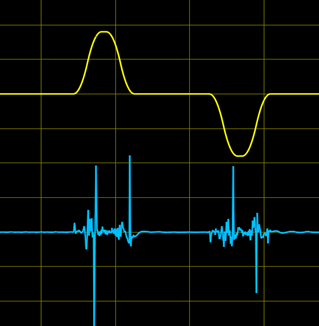
Blue: ServoBoost + LearningBoost
In an aggressive 50 mm move-and-settle motion, the combined ServoBoost + LearningBoost configuration reduced following error from approximately ±5 µm (standard control) to ±600 nm. A bonding demonstration also reported a 60% reduction in error during motion and approximately 60–70% reduction in settling time. These are demonstration-system results rather than a guarantee for every machine, but they illustrate why advanced control can matter to high-throughput bonding equipment.
Through-glass-via (TGV) laser drilling
TGV laser processing introduces a somewhat different challenge.
Instead of focusing only on the final settling position, the process may require very low error and smooth, predictable velocity throughout the entire move, including acceleration & deceleration through a processing region.
LearningBoost is targeted at TGV laser drilling because it can reduce dynamic error during acceleration and help maintain more consistent high-performance motion throughout the process.
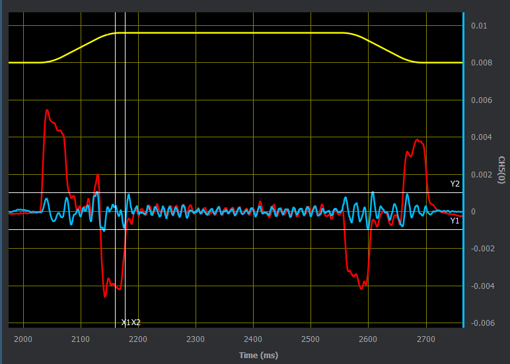
In the TGV demonstration, ServoBoost + LearningBoost reduced acceleration error from approximately ±5 µm to ±1 µm, while the reported time to settle into constant velocity improved from 17 ms to less than 1 ms which helps significantly improve throughput.
Electronics and PCB assembly
Pick-and-place equipment presents another classic high-throughput motion-control problem: large numbers of extremely short moves repeated continuously.
Here, milliseconds add up quickly.
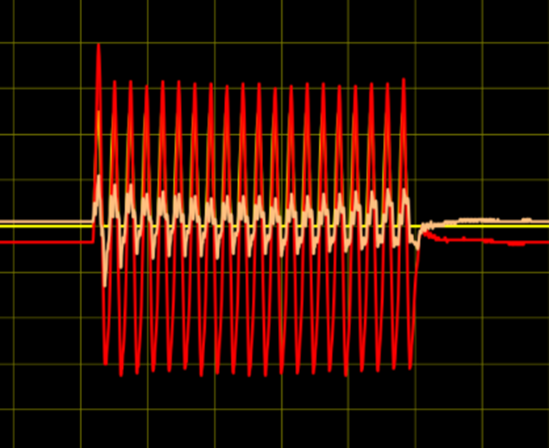
LearningBoost targets fast pick-and-place applications where reducing both following error and move-and-settle time can directly increase machine cycle rate.
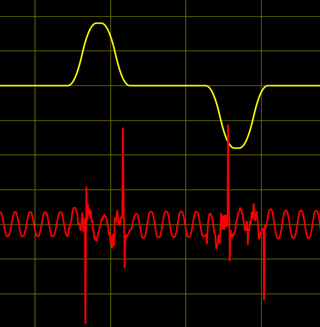
Right: Red signal – position error (PE) with PIVFF (+/-6.5 um, Yellow signal – PE with LB (+/-1.75 um)
Inspection and metrology
Inspection equipment presents an interesting control tradeoff: throughput frequently depends on scanning faster, while measurement performance depends on keeping motion disturbance extremely small.
That makes disturbance rejection particularly important.
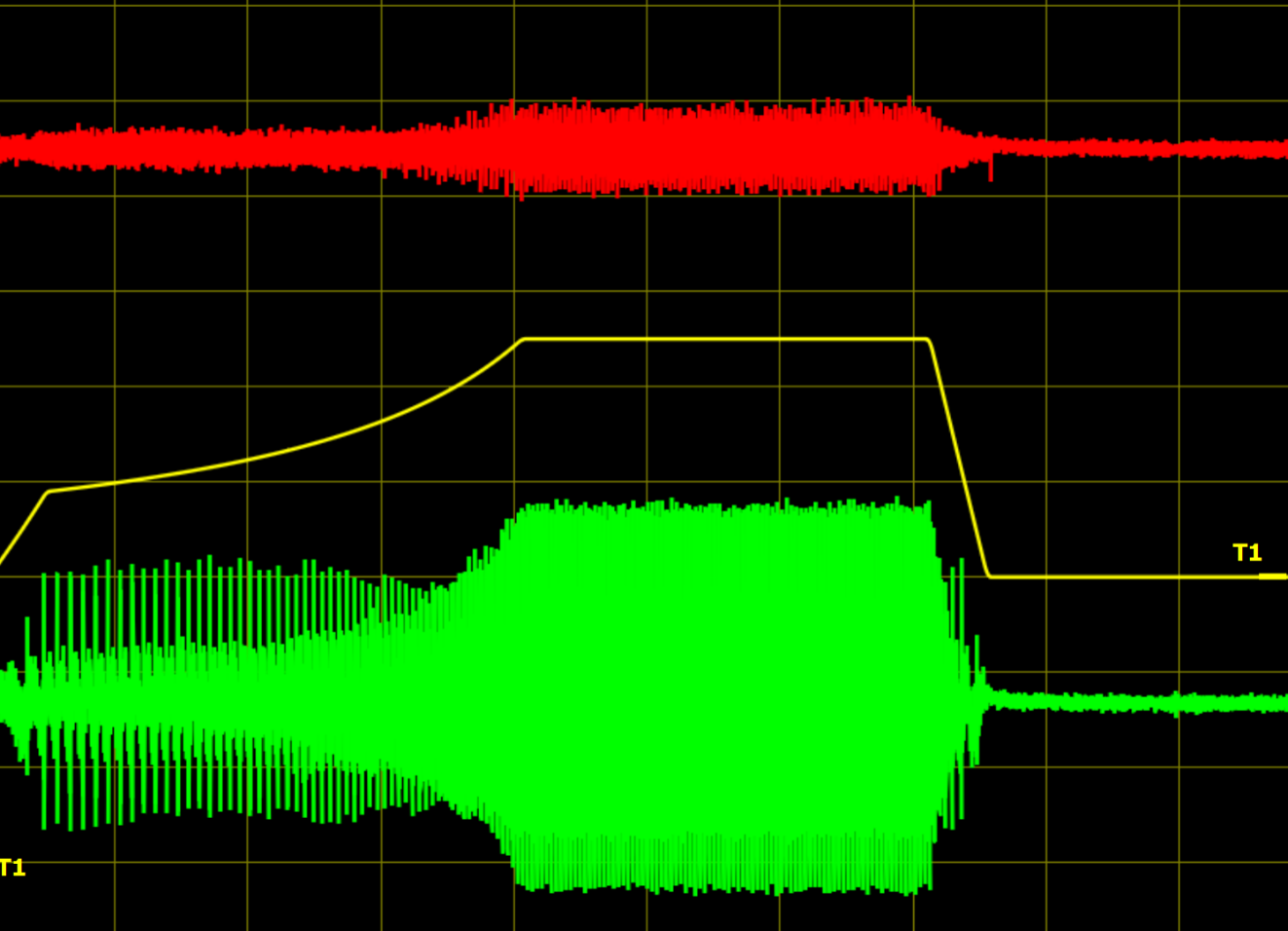
scanning motion
LearningBoost is designed for scanning and spiral-motion processes where cross-axis coupling would otherwise produce unwanted position error.
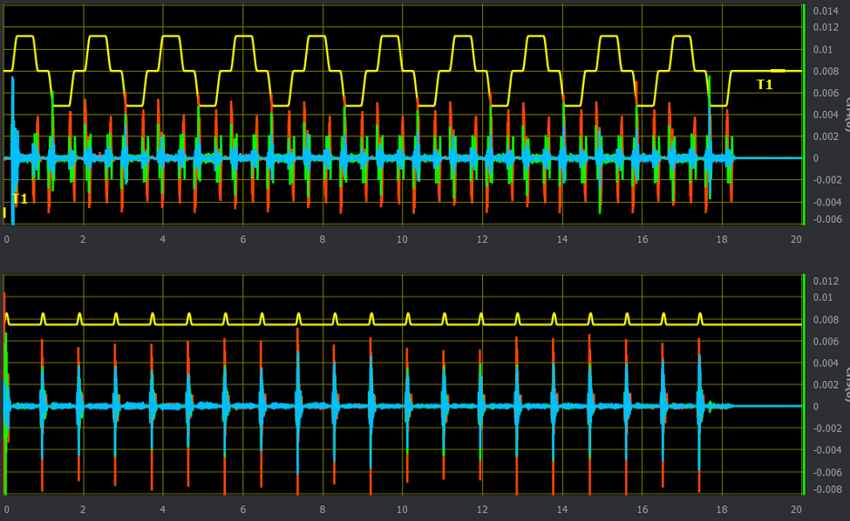
This demonstration shows position error during spiral scanning decreasing from approximately ±100 nm with PIVFF to ±25 nm with LearningBoost, a 4X reduction in that application.
Left: Yellow signal Theta velocity (1000 rpm max), Green signal – PE w PIVFF (+/-100 nm, Red signal – PE w LB Mode (+/-25 nm)
Laser processing, additive manufacturing and dispensing
Systems following complex 2D or 3D trajectories must maintain both geometric accuracy and consistent velocity.
Cross-axis interaction, changing direction and high acceleration can make that difficult.
LearningBoost can complement ACS technologies for advanced contouring and motion-profile generation by reducing dynamic error as the axes execute demanding trajectories. The algorithm is specifically targeted at laser, additive and dispensing applications involving coordinated multi-axis trajectories.
Biomedical and genomic instrumentation
Genomic instruments can execute hundreds of rapid positioning moves within a process.
When those sequences are repeated across long workflows (1000s of points), even relatively small reductions in individual move-and-settle times (milliseconds) can accumulate into meaningful process-time savings.
An intelligent layer within the SPiiPlus Platform
LearningBoost is not a standalone motion-control product. It is part of ACS Motion Control’s broader SPiiPlus EtherCAT motion-control platform, which includes multi-axis motion controllers, integrated controller/drive products, universal servo drives, intelligent drive modules, I/O and interface products.
That distinction is important.
Improving machine throughput rarely comes from optimizing a single algorithm in isolation. Performance is the result of the controller, servo drive, motion profile, feedback system, mechanics and application process working together.
LearningBoost can therefore complement other ACS motion technologies, including:
- ServoBoost™ for advanced real-time servo performance, disturbance rejection and settling.
- MotionBoost™, which ACS positions for increasing throughput and accuracy in rapid, short-duration moves.
- SmoothPTP, designed to reduce motion-induced resonances and enable higher velocity and acceleration.
- SmoothPath, targeted at increasing throughput in advanced contour-motion applications.
- Force Control for applications requiring precision force control and on-the-fly contact detection.
- NanoPWM™, ACS servo-drive and algorithm technology for sub-nanometer precision.
- Smarter Gantry Control, an advanced multi-input, multi-output gantry-control capability.
- Dynamic Error Compensation, used to compensate mechanical stage accuracy imperfections.
Explore the broader ACS Motion Control product portfolio and Product Map for controllers, integrated drives, universal servo drives, Intelligent Drive Modules, I/O, interfaces and accessories.
From reactive correction to adaptive motion performance
As precision machines become faster, the question is no longer simply, How tightly can we tune the servo?
A better question is:
How can the motion-control system anticipate and compensate for dynamic errors that limit the machine’s real production performance?
That is where LearningBoost introduces a new dimension to precision motion control.
By learning motion-system behavior, adapting to changes and providing pre-emptive compensation, LearningBoost gives OEM engineers another way to attack the errors that appear when equipment is pushed toward higher acceleration, shorter settling times and greater throughput.
Combined with ServoBoost and the broader SPiiPlus motion-control platform, it creates an integrated approach to higher servo performance, improved disturbance rejection, lower dynamic positioning error and reduced commissioning effort.
Learn more:
- Explore LearningBoost™
- Explore ServoBoost™
- Explore ACS Servo Control capabilities
- View the LearningBoost webinar for demonstrations and application examples in advanced packaging, bonding and through-glass-via laser processing.
- Explore the SPiiPlus Platform and ACS product portfolio