
Minimizing Time‑to‑Market with ACS: Flexibility Through APIs for Every Major Programming Environment
|
Minimizing Time‑to‑Market with ACS: Flexibility Through APIs for Every Major Programming Environment
In today’s competitive landscape, OEMs face constant pressure to shorten development cycles while delivering increasingly sophisticated motion‑control capabilities. Machine builders need the freedom to develop host applications using the tools, languages, and operating systems they already rely on—without compromising performance, usability, or reliability.
ACS Motion Control delivers exactly that.
With one of the industry’s most extensive sets of host application libraries (APIs)—spanning C, C++, C#, .NET, Python, MATLAB, LabVIEW, Linux, macOS, and low‑level socket interfaces—ACS enables unmatched development flexibility and dramatically reduces time‑to‑market.
APIs for Virtually Any Programming Language
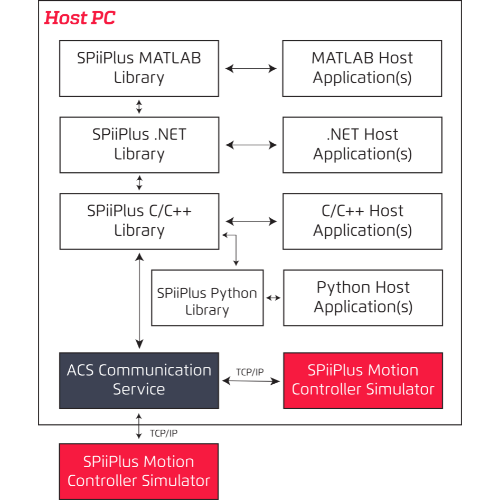
ACS host application libraries provide a comprehensive ecosystem that supports all controller models, including the Controller Simulator, allowing engineers to write applications using their preferred development environments. These libraries include:
- C / C++ libraries
- COM and .NET libraries
- MATLAB and LabVIEW libraries
- Python libraries
- Linux and macOS support
- Low‑level TCP/IP socket interfaces

Beyond language flexibility, ACS provides rich built‑in callback options, user‑defined callbacks, and data‑collection capabilities—all designed to streamline host‑side machine logic and UI development. Sample projects included with the ADK Suite help teams get up and running fast.
Reduced Development Time Through Unified Tools
The real power of this multi‑language API suite becomes clear when paired with the MMI Controller Simulator. Developers can build and debug host applications without hardware, simulating motion responses, faults, and machine inputs in real time. This significantly speeds up feature validation and UI prototyping.
Engineers can:
- Develop and test host applications across C, .NET, Python, Linux, MATLAB, and more before hardware arrives
- Run full controller simulations with up to 128 virtual axes and 64 program threads
- Validate machine logic and visualization tools through simulated workflows
This approach dramatically reduces machine ramp-up time and the risks associated with integrating software late in the development cycle.
Compatibility That Scales Across Applications
Whether the goal is building a custom HMI, deploying real‑time data acquisition dashboards, or integrating complex motion logic into a factory‑level software suite, ACS APIs enable seamless communication with controllers over Ethernet TCP/IP.
Because the host libraries are standardized across all ACS controllers, machine builders can reuse code across platforms, reduce overhead in multi‑machine deployments, and maintain consistent UI/UX across product lines.
Focus on Performance, Not Data Pushing
With ACS handling communication robustness, event callbacks, and high‑level motion coordination, development teams can focus on what matters most—creating differentiated user interfaces and workflows that elevate machine performance.
Moreover, when combined with ACSPL+ for real‑time logic, engineers can offload time‑critical tasks to the controller while the host application handles visualization, orchestration, MES/SCADA communication, recipe management, and more.
Conclusion: Flexibility That Translates Directly to Speed
ACS host application libraries provide:
- Broad and deep multi‑language support
- A consistent API model across controllers
- A powerful simulator for rapid development
- Built‑in features that reduce coding effort and improve reliability
For OEMs building next‑generation semiconductor, electronics, laser-processing, biomedical, or precision‑automation equipment, this flexibility means faster development cycles, lower engineering effort, and shorter time‑to‑market.
With ACS, your software team can innovate faster—on the tools they know best.